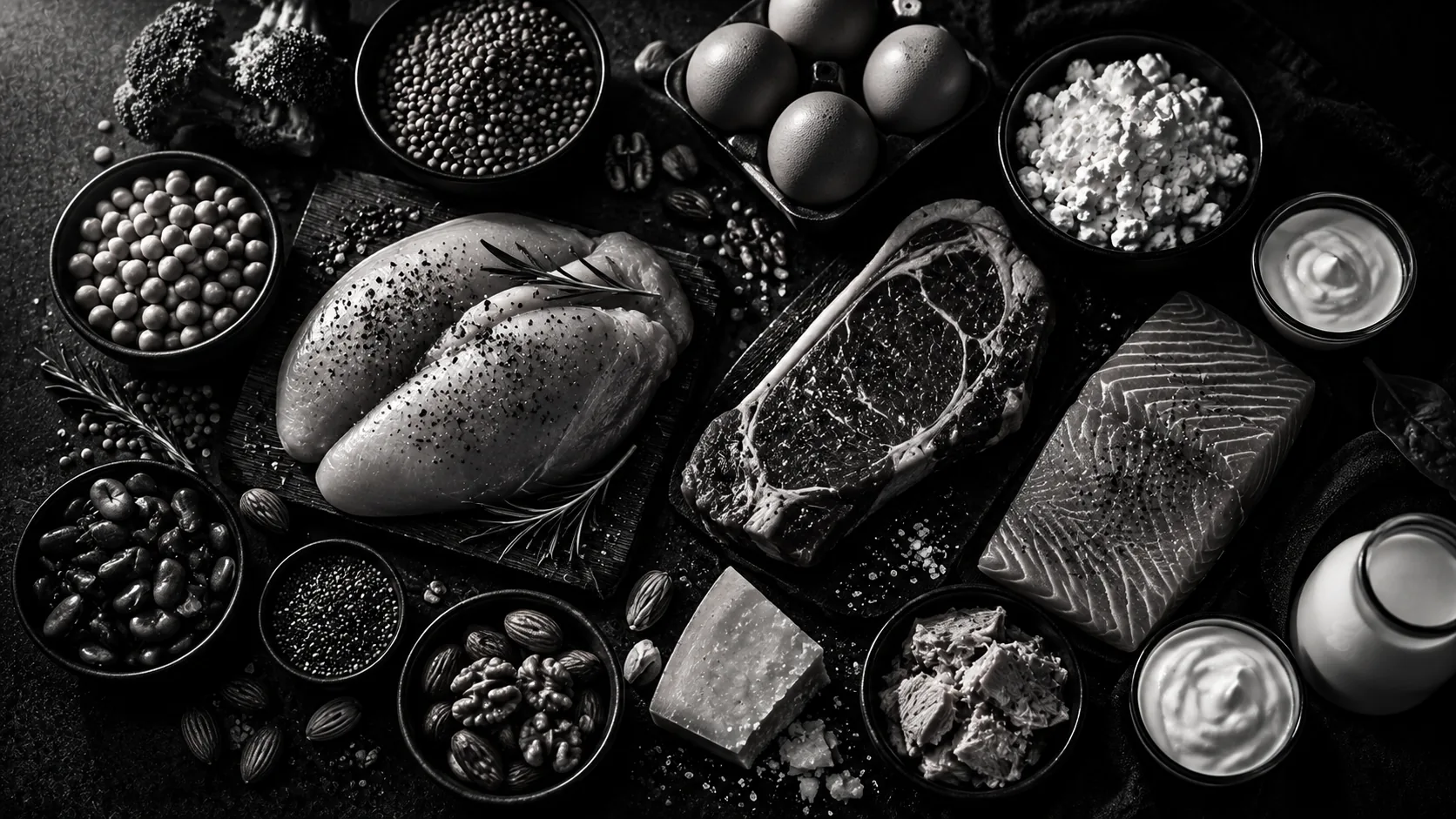
Why protein matters for body composition
Protein is the macronutrient that matters most when your goal is building muscle, losing fat, or doing both at once. It provides the amino acids your body uses to repair and build muscle tissue after training — without enough of it, consistent resistance training produces far less muscle growth than it should.
Protein is also the most satiating macronutrient. Higher-protein diets reduce hunger, which makes maintaining a calorie deficit easier during a cut. And unlike carbohydrates or fat, protein is rarely stored as body fat — the body prefers to use it for repair, enzymes, hormones, and other structural roles.
Whether you're in a gaining phase or a cutting phase, hitting your daily protein target is one of the highest-leverage nutrition habits you can build. For a full breakdown of the evidence on daily intake, see our guide to how much protein per day.
How much protein do you actually need?
The evidence-based consensus for people training for muscle growth sits at roughly 1.6–2.2 g of protein per kilogram of body weight per day. For most purposes, aiming for around 2 g/kg is a reliable, achievable target that covers the full range of evidence.
Context matters here. During an aggressive calorie deficit, slightly higher intakes — toward the upper end of that range or modestly above — help preserve lean mass. Older adults may also benefit from the higher end due to reduced muscle protein synthesis efficiency with age.
Rather than calculating by hand, use the protein calculator at sammagym.com to get a personalised daily target based on your body weight, training status, and goal. Once you have that number, the challenge isn't knowing the target — it's building food habits that reliably hit it.
For a deeper look at how protein intake distributes across meals and what the research says about per-meal limits, see our companion article on how much protein per meal.
Animal-based protein sources
Animal proteins are complete proteins — they contain all nine essential amino acids in proportions well-suited to human muscle protein synthesis. They're also calorie-efficient sources of leucine, the amino acid most directly responsible for triggering muscle protein synthesis.
Chicken breast and turkey breast are the workhorses of high-protein diets for good reason. They're among the leanest sources available, meaning you get a large amount of protein per calorie. Chicken thighs and turkey legs are slightly higher in fat but still excellent — and arguably more practical for meal prep because of better moisture retention.
Lean beef (sirloin, round cuts, or extra-lean mince) provides protein alongside iron and creatine precursors. Fattier cuts like ribeye are still solid protein sources, but the calorie count climbs fast — worth accounting for during a cut.
Fish and seafood deliver an excellent protein-to-calorie ratio across many options. White fish (cod, haddock, tilapia) is extremely lean. Canned tuna in water is one of the most cost-effective high-protein foods at any supermarket. Salmon and other oily fish are higher in fat but deliver omega-3 fatty acids alongside high-quality protein — a trade-off worth making several times a week.
- Shrimp and prawns. Very high protein, very low fat. Fast to cook and work well in stir-fries, salads, and pasta.
- Eggs. Whole eggs provide high biological value protein along with fat-soluble vitamins and choline. Egg whites strip out almost all fat and calories while keeping the protein. A practical combination is 2–3 whole eggs plus additional egg whites.
- Greek yogurt (plain, full-fat or low-fat). One of the most versatile high-protein dairy foods. Plain Greek yogurt has significantly more protein than standard yogurt — low-fat versions push the protein-to-calorie ratio even higher. Works as breakfast, a snack, or a sauce base.
- Cottage cheese. Often overlooked. It's exceptionally high in protein and predominantly casein — a slow-digesting protein that makes it a solid option before sleep. Low-sodium varieties are widely available.
- Milk. Whole, semi-skimmed, or skimmed — all provide a mix of whey and casein protein. Semi-skimmed and skimmed milk increase protein density per calorie. A practical way to add protein to shakes, oatmeal, and cooking.
Plant-based protein sources
Plant proteins have a well-documented limitation: most individual plant foods are incomplete, meaning they're low or missing in one or more essential amino acids. In practice, this is easily managed by eating a variety of plant protein sources across the day — the complementary amino acid profiles fill the gaps without requiring precise food combining at every meal.
The more relevant practical challenge is protein density. Plant foods tend to carry more carbohydrates or fat per gram of protein than animal sources, so you need to eat a larger total volume to hit the same target. Manageable — but worth planning for.
Legumes are the most protein-dense plant foods in common use. Lentils, chickpeas, black beans, kidney beans, and white beans all provide meaningful protein alongside fibre and complex carbohydrates. Lentils stand out for their relatively high protein content and fast cooking time. Edamame (immature soybeans) is particularly notable — it has one of the best amino acid profiles of any plant food, closer to animal-quality protein than most legumes.
Tofu is made from soybeans and is a nutritionally complete protein source — unusual among plant foods. Firm and extra-firm tofu are higher in protein per serving than silken varieties, and they absorb flavours readily. Tempeh is fermented tofu and offers even higher protein density along with probiotic benefits.
- Seitan (wheat gluten). One of the densest plant protein sources by weight. Not suitable for people with coeliac disease or gluten sensitivity. Works well as a meat substitute in cooked dishes.
- Soy milk and soy-based dairy alternatives. Soy milk is the only widely available plant-based milk with protein content comparable to cow's milk. Other plant milks (oat, almond, rice) contain very little protein.
- Nutritional yeast. A complete protein and a practical flavour booster — nutty, cheesy taste. High protein relative to serving size. Works in sauces, soups, and as a seasoning.
- Quinoa. A grain-like seed and one of the few complete plant proteins. Solid protein per serving relative to other grains, though not as dense as legumes.
- Hemp seeds. Complete protein, good omega-3 content, easy to add to smoothies, yogurt, or oatmeal with minimal flavour impact.
For vegetarians and vegans aiming for performance-level protein intakes, combining legumes, tofu or tempeh, soy-based dairy, and a plant-based protein powder (see below) is the most reliable path to hitting a 1.6–2.2 g/kg target consistently.
Protein powder: useful tool or unnecessary?
Protein powder isn't a required food. Whole food sources are nutritionally superior in most ways — they come with micronutrients, fibre, and satiety signals that powders don't replicate. The case for protein powder is purely practical: it's fast, convenient, portable, and often cost-effective — a way to add protein without adding much volume, cooking time, or meal complexity.
Whey protein is derived from milk (a by-product of cheese production) and is the most studied protein supplement. It's high in leucine and digests quickly, making it a practical post-workout option. Whey concentrate is cheaper; whey isolate has more protein per gram with less fat and lactose — relevant if you're lactose-sensitive.
Casein protein is the other major milk-derived protein. It digests slowly and provides a sustained release of amino acids over several hours. Often positioned as a pre-sleep protein source, though the practical advantage over cottage cheese or Greek yogurt before bed is debatable.
Plant-based protein powders — typically pea, rice, hemp, or blends — are the go-to for vegans and people with dairy intolerances. Pea protein is the most studied plant protein powder, with evidence suggesting it produces muscle growth outcomes similar to whey when matched for leucine content. Rice protein alone is lower in lysine, which is why pea-rice blends are common — the amino acid profiles complement each other.
High-protein foods at a glance
The table below groups major protein sources by category with approximate protein content per 100 g as typically prepared or purchased. Values vary by brand, preparation method, and specific cut — use these as rough planning tools, not precise nutritional data.
These figures are starting points. For precise tracking, a nutrition database or app with verified entries will give more accurate values for specific products and preparation methods.
Practical strategies to hit your daily target
Knowing the best high-protein foods is only half the equation. The harder part is consistently reaching your target across real days — busy schedules, limited cooking time, eating out, and fatigue all work against good intentions. These strategies close that execution gap.
Anchor each meal with a protein source. Choose a protein food first, then build the rest of the meal around it. Breakfast with Greek yogurt or eggs, lunch with chicken or tuna, dinner with fish or legumes — this structure alone gets most people 60–80% of their target before snacks.
- 1Calculate your target first. Use the protein calculator at sammagym.com to get a personalised number in grams per day. Without a specific target, tracking progress is impossible.
- 2Distribute across 3–4 meals. Spreading protein intake across multiple meals is more practical than trying to hit a large total in one or two sittings. Aim for roughly equal portions at each meal. For details on the per-meal evidence, see our article on how much protein per meal.
- 3Prep protein in bulk. Cooking chicken breast, hard-boiling eggs, or batch-cooking lentils for three to four days reduces friction. If the protein is already cooked, assembling a high-protein meal takes minutes.
- 4Keep portable protein on hand. Greek yogurt, cottage cheese, canned tuna, hard-boiled eggs, edamame, and protein bars or shakes travel without refrigeration (for the shelf-stable options) or with minimal preparation. These close gaps when cooking isn't practical.
- 5Add protein to meals that currently lack it. A salad with no protein source is a missed opportunity — add tuna, chicken, eggs, or chickpeas. Oatmeal can be boosted with Greek yogurt, a scoop of protein powder stirred in, or a side of eggs. Look for zero-protein meals in your current diet and fix them one at a time.
- 6Use protein powder strategically. If a shake after training or before bed reliably closes a 20–30 g daily gap, it earns its place. If the gap is structural — meaning your meals simply don't contain enough whole food protein — fix the food structure first.
For context on how protein intake interacts with your calorie target during a muscle-building phase, see our guide on how many calories to build muscle.
Sources
- Morton R.W., Murphy K.T., McKellar S.R., et al. — A systematic review, meta-analysis and meta-regression of the effect of protein supplementation on resistance training-induced gains in muscle mass and strength in healthy adults, British Journal of Sports Medicine, 2018.
- Stokes T., Hector A.J., Morton R.W., et al. — Recent Perspectives Regarding the Role of Dietary Protein for the Promotion of Muscle Hypertrophy with Resistance Exercise Training, Nutrients, 2018.
- van Vliet S., Burd N.A., van Loon L.J. — The Skeletal Muscle Anabolic Response to Plant- versus Animal-Based Protein Consumption, Journal of Nutrition, 2015.
- Berrazaga I., Micard V., Gueugneau M., Walrand S. — The Role of the Anabolic Properties of Plant- versus Animal-Based Protein Sources in Supporting Muscle Mass Maintenance: A Critical Review, Nutrients, 2019.
- Helms E., Morgan A., Valdez A. — The Muscle and Strength Pyramids: Nutrition, 2nd edition, 2019.
- Nippard J. — The Fundamentals Hypertrophy Program — Nutrition Module, Jeff Nippard Fitness, 2021.
- American College of Sports Medicine — Nutrition and Athletic Performance (Joint Position Statement with AND and DC), Medicine & Science in Sports & Exercise, 2016.